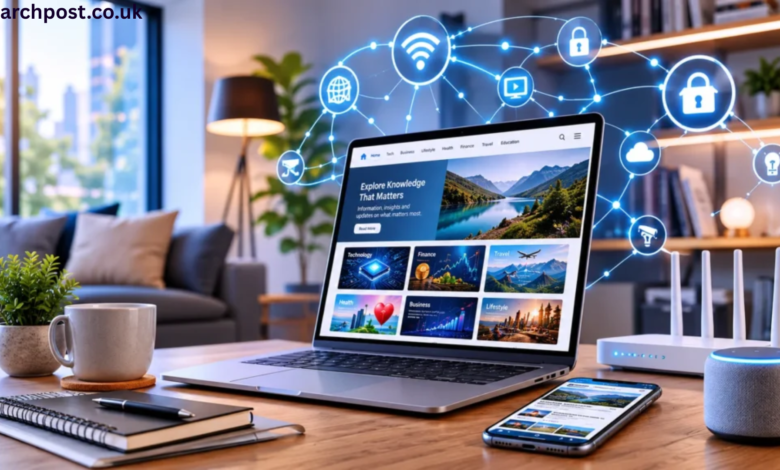
Smart-home technology has moved from being a futuristic idea to becoming part of everyday life. From smart lights and thermostats to cameras, door locks, and connected appliances, modern homes are becoming increasingly digital.
Domikyo.com is often associated online with topics such as smart homes, IoT, connected devices, networking, and digital living. While descriptions of the website vary, it is best understood as an online information resource rather than a manufacturer of smart-home products.
This article explains the main technologies connected with modern smart living and how they work together.
Quick Facts
| Detail | Information |
|---|---|
| Website | Domikyo.com |
| Website Type | Online Information Platform |
| Main Topic | Smart Home Technology |
| Related Field | Internet of Things (IoT) |
| Focus Area | Connected Devices |
| Technology | Home Automation |
| Connectivity | Wi-Fi, Bluetooth, Thread |
| Smart Standard | Matter |
| Common Devices | Lights, Locks, Cameras, Sensors |
| Key Benefit | Convenience and Automation |
| Important Concern | Security and Privacy |
| Target Readers | Smart-Home and Technology Users |
| Content Purpose | Understanding Connected Living |
What Is Domikyo.com?
Domikyo.com appears to be an informational website covering digital topics, including technology and connected living.
Some online sources associate the site strongly with smart-home technology, IoT devices, networking, and modern digital lifestyles. However, it should not be confused with a company that manufactures smart devices.
For readers, Domikyo.com can be viewed as one of many online resources used to learn about technology and connected-home concepts.
What Is a Smart Home?
A smart home uses connected devices that can communicate with users, networks, or other devices.
For example, a smart light can be controlled through an app, while a smart thermostat can automatically adjust temperature based on a schedule.
Smart homes become more useful when several devices work together. A user might create a routine that turns off lights, adjusts heating, and activates security features when leaving the house.
The goal is simple: make everyday tasks easier, more convenient, and more efficient.
Understanding IoT
IoT stands for the Internet of Things.
It refers to physical devices that can connect to networks, exchange information, and perform digital functions.
Common household IoT devices include:
- Smart cameras
- Thermostats
- Doorbells
- Smart locks
- Sensors
- Smart plugs
- Speakers
- Connected appliances
These products often depend on software, mobile apps, wireless networks, and sometimes cloud services.
A smart camera, for example, may use Wi-Fi to connect to a home router and send notifications to a user’s phone.
Connected Devices
A connected device is any product capable of communicating with another system or device.
Some devices receive commands, while others provide information.
A motion sensor might detect movement and trigger a hallway light. A door sensor could send an alert when a door opens. A thermostat may adjust temperature automatically.
This ability to share information is what allows smart-home systems to become more useful than ordinary household devices.
Home Networks
A strong home network is essential for a reliable smart home.
Many connected products rely on Wi-Fi or other wireless technologies. If the network is weak, even a high-quality smart device may respond slowly or disconnect.
The home router therefore plays an important role.
Good Wi-Fi coverage, updated networking equipment, secure passwords, and proper router placement can improve the reliability of connected devices.
Before adding many smart products, it is wise to make sure the home’s internet and wireless network are stable.
Wi-Fi and Bluetooth
Different smart-home devices use different communication technologies.
Wi-Fi is common because many homes already use it. Cameras, televisions, speakers, and other devices can connect directly to a home network.
Bluetooth is mainly useful for short-range communication and device setup.
Some smart-home products use other technologies because they require lower power consumption or better mesh networking.
That is where technologies such as Thread become important.
What Is Thread?
Thread is a wireless networking technology designed for smart-home and IoT devices.
It uses a low-power mesh network. In a mesh network, compatible devices can help pass information across the system instead of relying completely on one direct connection.
This can improve reliability and coverage.
Thread is particularly useful for smaller connected devices such as sensors, locks, and other products where battery life matters.
However, Thread is mainly responsible for networking. It does not by itself determine how different smart-home products understand each other.
What Is Matter?
Matter is a smart-home standard designed to improve compatibility between connected products.
One major problem with smart-home technology has been that devices from different brands do not always work together easily.
Matter aims to reduce that problem.
Compatible Matter devices can communicate through a standardized system, making it easier for products from different manufacturers to operate within the same smart-home environment.
Matter and Thread are different technologies.
Thread provides networking, while Matter focuses on interoperability and communication between compatible smart-home products.
Home Automation
Automation is one of the most useful parts of smart-home technology.
Instead of manually controlling every device, users can create routines that perform actions automatically.
For example:
- Lights can turn on when motion is detected.
- Heating can adjust at bedtime.
- Security alerts can activate when nobody is home.
- Smart plugs can turn devices off at specific times.
Good automation should solve practical problems.
A smart home does not need dozens of complicated routines. Simple, reliable automation is often more useful.
Main Benefits
Smart-home technology can provide several practical benefits.
Convenience is one of the biggest. Users can control devices remotely or automate repetitive tasks.
Connected devices may also help with energy management by providing information about electricity use or allowing users to control heating and lighting more effectively.
Security is another common use. Cameras, doorbells, sensors, and smart locks can provide alerts and remote monitoring.
Smart technology can also improve accessibility by making household controls easier to operate through apps, voice commands, or automated routines.
Security and Privacy
Connected devices also create new security and privacy responsibilities.
Every smart product may introduce another account, app, network connection, or source of personal data.
Users should choose strong passwords, install firmware updates, enable multi-factor authentication where possible, and keep their router secure.
It is also important to review privacy settings.
Smart cameras, speakers, televisions, and sensors may collect information about household activity. Users should understand what data is collected and how it is used.
A connected device should provide enough value to justify the information it requires.
Buying Smart Devices
Before buying a smart-home product, consumers should check more than price.
Important factors include:
- Device compatibility
- Wireless requirements
- Software support
- Security updates
- Privacy policies
- Subscription fees
- Cloud dependence
- Battery requirements
- Manufacturer support
It is usually better to start with one or two useful devices rather than trying to automate an entire home immediately.
Where Domikyo.com Fits
Domikyo.com can be treated as an informational resource for readers researching technology, smart homes, IoT, networking, and connected devices.
However, important technical claims should always be compared with reliable sources such as official manufacturers, standards organizations, and cybersecurity authorities.
No single website should be the only source used when making decisions about security, privacy, or expensive connected equipment.
Final Thoughts
Domikyo.com is associated online with the growing world of smart homes, IoT, connected devices, and digital technology.
Understanding these technologies does not need to be complicated.
IoT connects physical devices. Smart homes bring those devices together. Automation allows them to perform tasks automatically. Thread can support low-power networking, while Matter helps compatible devices communicate more easily.
The best smart home is not necessarily the one with the most gadgets. It is the one where technology is useful, secure, compatible, and reliable.
FAQs
What is Domikyo.com?
Domikyo.com is an online information resource associated with topics such as smart homes, IoT, connected devices, networking, and digital technology.
What does IoT mean in a smart home?
IoT means the Internet of Things. It refers to connected devices such as smart lights, cameras, sensors, locks, and thermostats that can share data or respond to commands.
Is Domikyo.com a smart-home product company?
Domikyo.com is better described as an informational website rather than a manufacturer of smart-home hardware or connected devices.
What is the difference between Matter and Thread?
Thread is a low-power networking technology for connected devices, while Matter is a standard designed to improve compatibility between supported smart-home products.
Are smart-home devices safe to use?
They can be used safely when users choose trusted products, install updates, use strong passwords, secure their router, and review privacy settings.







One Comment